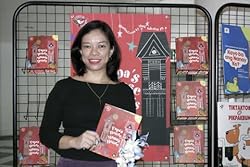
Who is
Jean lee Patindol?
Patindol is a single mother of
three, who works as an assistant professor at the University of St. La Salle in Bacolod, teaching Economics, Communications and Culture courses. She started writing at an
early age but only started taking courses on writing creative fiction and
poetry at the age of 32. She was granted several fellowship grants to different
writing workshops. Her first children's story Amah's
Rebellion which resulted from
her first workshop was accepted for publication by Whispers from Heaven, a
publishing company based in Illinois,
U.S.A.
She won the Philippine Board on Books for
Young People Salanga Writers'
Prize in 2004 for her
book entitled Papa's House,
Mama's House and received the
same award in 2007 for her book Tight
Times.
In 2007, she signed her first
international book contract with Living
Waters Publishing Company for
another one of her masterpieces entitled, My
One-Boobed Mamma. She also does volunteer work for Pax Christi Pilipinas and for PECOJON – The Peace and Conflict Journalism
Network and at theNegros Museum as a storyteller.
One of her famous works is the story intitled

“Papa's House, Mama's House”
In Papa’s House, Mama’s House three
siblings divide their time between the homes of their mother and father. Some
things are the same in both households (they eat some of the same foods, play
the same games), but others are not. Whereas “in our home with Papa we have
many rules. I don’t remember all of them.” in Mama’s house “We only have two
rules: “ ‘Be honest’ and ‘Clean up your own mess’.”
Papa’s House,
Mama’s House approaches the topic of divorce, a situation experienced
by more and more kids throughout the world, from the point of view of one of
the children in the family. From a positive angle not always present in
chidren’s books (which tend to portray divorce as a family “problem”), the
young narrator reveals that, despite the changes in his routine, his parents’
love for him is still the same. Indeed, Mark Salvatus’ multi-media
illustrations, while detracting from the story at times with their bright red
double-page spreads, provide an overall tone of happiness to the narrative.
That doesn’t mean, however, that there aren’t mixed feelings to be dealt with:
“Sometimes it makes me tired going back and forth… Sometimes it makes me sad,
too.”
An author’s note
at the end of the book explains the story was motivated by the author’s
own divorce and desire to explain to her son that their new situation needn’t
change his idea of what it means to be a family. “It’s interesting how the way
we define our concepts in our minds affects the degree to which we gracefully
accept or struggle with the realities in our lives,” she offers.
The author also says
in her note: “In an increasingly complicated world… I strongly believe in
bringing up children with a respect and appreciation for diversity and
practical examples of struggling to learn how to live as peaceablyand
harmoniously as one can, amidst differences”. And, true to her intentions, she
ends the story with the celebration of the young narrator’s birthday party,
where Mama and Papa stand side by side, after working as a team, “peaceably and
harmoniously,” to put the party together.
This is a lovely and
honest book to help children understand that there are many ways to be - and
remain - a family.
ILLUSTRATION:
When words can't describe
how one feels, pictures can. This is how Sergio Bumatayperceived,
reviewed and interpreted Papa's House, Mama's House:
The illustrations have bold strokes of provocative colors with
small sketchy figures. The heavy painterly style and scratch techniques work
both ways: it may either suggest the deep unsettling feelings of the character
perfectly expressed through colors and strokes, or the style symbolizes the
love of parents for the character which doesn't diminish despite their
situation. While looking at the illustrations, you can actually feel those
emotions as you read. The small figures may connote that we play deaf in
children's honest and pure voices about issues and they should also matter in
adult decisions, no matter how young they are. How often do we disregard or
underestimate a child's understanding?

Walang komento:
Mag-post ng isang Komento